pRI 909 and pRI 910 binary vectors
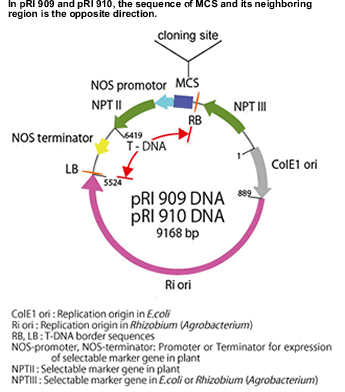
The Ri pRI 909 and pRI 910 binary vectors are intended for Agrobacterium-mediated plant transformation and contain a region of T-DNA for Arabidopsis, tomato, tobacco, and rice transformation. The origin of the T-DNA is the vir region-lacking Rhizobium (Agrobacterium) rhizogenes Ri plasmid. pRI 909 and pRI 910 are also shuttle vectors and replicate autonomously in E. coli and Rhizobium (Agrobacterium).
In E. coli, these vectors are capable of achieving a high copy number because they contain the ColE1 replication origin. The ColE1 ori, as well as the mutant-type Ri plasmid replication of origin (Ri-ori), are each stably maintained in Rhizobium (Agrobacterium). These vectors also contain the kanamycin-resistance gene NPTIII for selection in E. coli and Rhizobium (Agrobacterium), and a mutant-type kanamycin-resistance gene NPTII for selection in plants.
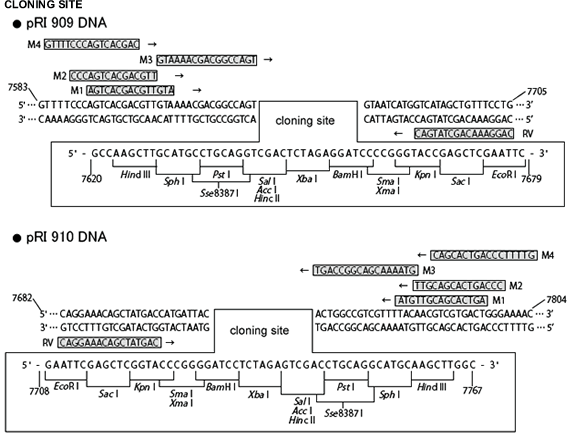
The pRI 909 and pRI 910 vectors are capable of plant transformation in combination with Rhizobium (Agrobacterium) through a binary vector system. Stable plant chromosome target gene integration is possible with pRI 909 and pRI 910 because their cloning sites are located in close proximity to the T-DNA Right Border (RB) and not the NPTII plant selection marker. As a result, the target gene is not deleted.
Overview
- Easy and stable plant chromosome target gene integration
- Improved agrobacterium-mediated plant transformation
- Applicable to various plants such as Arabidopsis, tomato, tobacco, and rice
Applications
- Rhizobium (Agrobacterium)-mediated plant transformation
- Arabidopsis, tomato, tobacco, rice transformation