

Cobalt resin FPLC cartridges for his-tagged protein purification
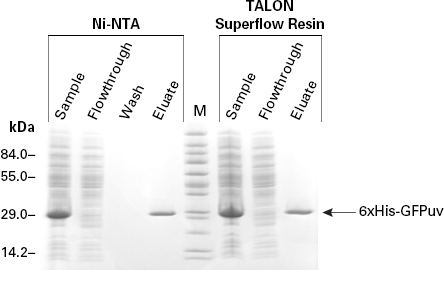
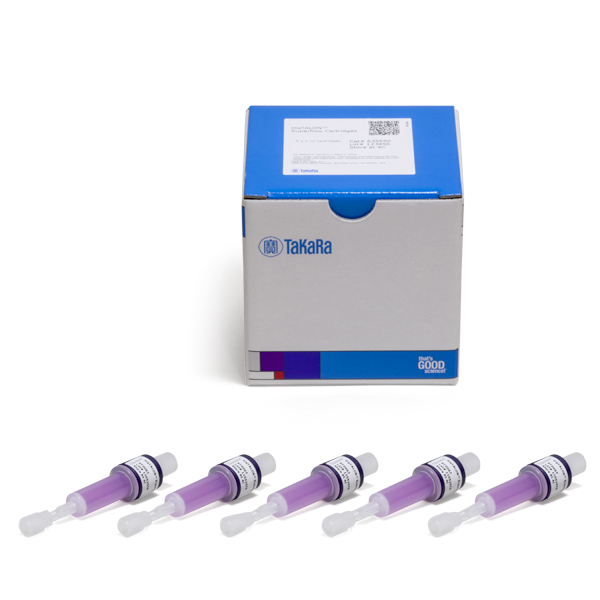
HisTALON Superflow Cartridges are FPLC cartridges prepacked with TALON Superflow Resin, which can withstand flow rates of 5–20 cm per min. This resin combines Superflow 6, a rigid, highly porous agarose derivative, with TALON. Columns prepacked with the resin can be used for efficiently purifying his-tagged proteins from a total soluble protein extract of bacterial, mammalian, or baculovirus-infected cells.
Overview
Choice of native or denaturing purification conditions
TALON Resin retains its protein binding specificity and yield under a variety of purification conditions. It is stable under both denaturing and native (nondenaturing) conditions. Deciding whether to use native or denaturing purification conditions depends on protein location, solubility, accessibility of the his tag, downstream applications, and preservation of biological activity.
Native conditions
Purifying a protein under native conditions is the most efficient way to preserve its biological activity, but requires that the protein be soluble. Advantages include:
- Eliminating the renaturation step at the end of the purification, saving time, and preventing significant loss of activity
- Retaining the ability to copurify enzyme subunits, cofactors, and associated proteins
Denaturing conditions
Because proteins that are overexpressed in prokaryotic systems sometimes form insoluble aggregates called inclusion bodies, you may need to purify proteins under denaturing conditions—using strong denaturants such as 6 M guanidinium or 8 M urea to enhance protein solubility. Advantages include:
- Complete solubilization of inclusion bodies and his-tagged proteins
- Improved binding to the matrix and reduced nonspecific binding, due to full exposure of the his tag
His-tagged proteins purified under denaturing conditions can be used directly in subsequent applications, or may need to be renatured and refolded. Protein renaturation and refolding can be performed prior to elution from the column. However, yields of recombinant proteins will be lower than under native conditions, because urea and guanidinium molecules compete with histidines for binding to metal.
Features
- Exhibits high affinity for his-tagged proteins
- Ideal for FPLC applications
- No copurification of proteins
- Resists metal leakage
- Performs well under a wide range of purification conditions
Applications
Purified recombinant his-tagged proteins can be used for:
- Crystallography
- Functional assays
- Structural investigations
- Other applications