Guide-it Indel Identification Kit

Additional information

Brand

Size

10 Rxns

The Guide-it Indel Identification Kit is used for characterization of insertions and deletions (indels) generated by gene editing tools, such as CRISPR/Cas9. This kit contains all of the components needed to amplify, clone, and prepare modified target sites for DNA sequence analysis. This kit uses Terra PCR Direct to amplify targets directly from crude genomic DNA extracts. The resulting pool of fragments, which may contain a variety of indels, are cloned into a prelinearized pUC19 vector using the In-Fusion cloning system. Colony PCR of individual clones using Terra PCR Direct followed by DNA sequencing allows indel characterization.

Overview

  • Streamlined method for characterizing the variety of indels introduced by gene editing technologies
  • Ultrafast protocol includes Terra PCR Direct Polymerase for PCR amplification directly from cells and the In-Fusion Cloning system for ligation-free cloning in 15 minutes
  • Ideal for identifying indels caused by Cas9/CRISPR, TALENs, or zinc-finger nuclease-based gene editing in a cell population
  • Complete kit contains all of the components needed to amplify, clone, and prepare modified target sites for DNA sequence analysis

Applications

  • Detecting insertions and deletions introduced in mammalian genomic DNA
  • Characterizing the variety of indels that are present in a cell population after nuclease-based gene editing
Components

  • Guide-it Indel Identification Components
    • 110 µl Terra PCR Direct Polymerase Mix
    • 3 x 1 ml 2X Terra PCR Direct Buffer (with Mg2+, dNTP)
    • 400 µl Extraction Buffer 1
    • 40 µl Extraction Buffer 2
    • 10 µl pUC19 Cloning Vector, linearized (50 ng/µl)
    • 200 µl Colony PCR Forward Primer (15 µM)
    • 200 µl Colony PCR Reverse Primer (15 µM)
    • 6 x 1 ml PCR-Grade Water
  • In-Fusion HD Cloning Kit
  • NucleoSpin Gel and PCR Clean-up kit
  • Stellar Competent Cells

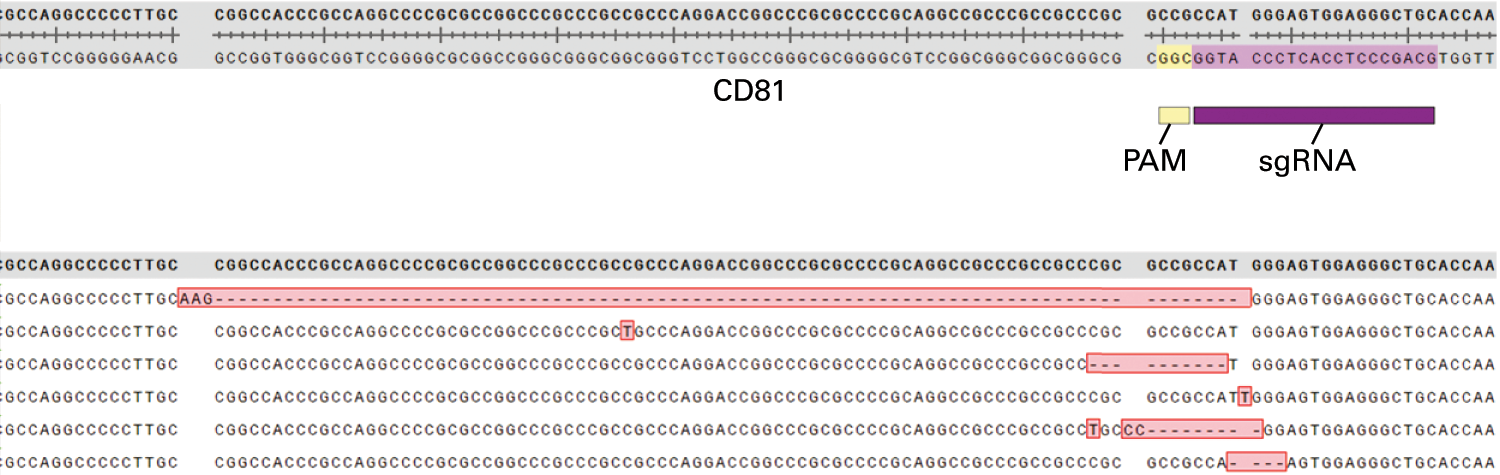
Identification of insertions and deletions (indels) in the CD81 gene after CRISPR/Cas9 targeting

Identification of insertions and deletions (indels) in the CD81 gene after CRISPR/Cas9 targeting

Identification of insertions and deletions (indels) in the CD81 gene after CRISPR/Cas9 targeting. HeLa cells were transfected with plasmids encoding Cas9 and an sgRNA targeting the CD81 gene. The Guide-it Indel Identification Kit was used to prepare CD81 target sites for DNA sequence analysis. The sequencing data from six clones was aligned with the wild-type sequence, revealing a broad range of indels in the CD81 gene.

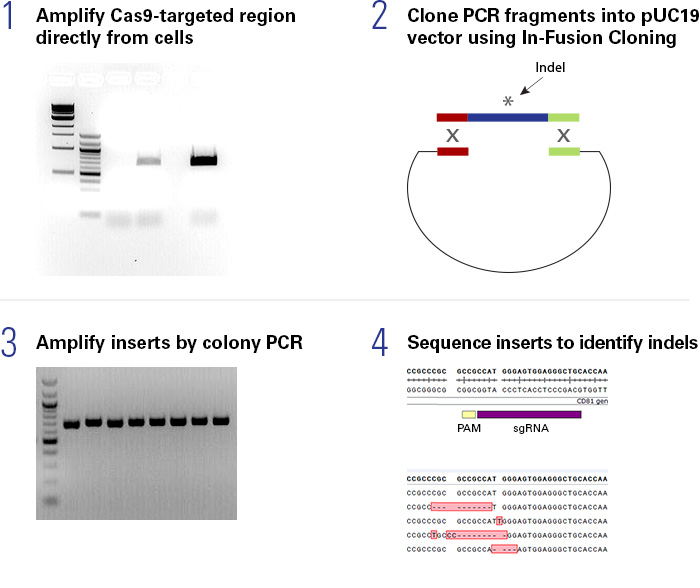
The Guide-it Indel Identification Kit provides a complete workflow for identifying the variety of insertions and deletions (indels) introduced by nuclease-based genome editing

The Guide-it Indel Identification Kit provides a complete workflow for identifying the variety of insertions and deletions (indels) introduced by nuclease-based genome editing

The Guide-it Indel Identification Kit provides a complete workflow for identifying the variety of insertions and deletions (indels) introduced by nuclease-based genome editing. The protocol uses direct PCR to amplify a genomic DNA fragment (~500 to 700 bp) containing the target site directly from crude cell lysates (step 1). The resulting amplified fragments contain a pool of edited target sites from individual cells. These PCR products are cloned directly into a pre-linearized pUC19 vector using the In-Fusion Cloning system (step 2). After transformation of an optimized E. coli strain, colony PCR is used to amplify the target site from the plasmid (step 3). DNA sequencing is then used to identify the different indels generated at the targeted genomic site (step 4)

The CRISPR/Cas9 system, a simple, RNA-programmable method to mediate genome editing in mammalian cells

The CRISPR/Cas9 system, a simple, RNA-programmable method to mediate genome editing in mammalian cells

The CRISPR/Cas9 system, a simple, RNA-programmable method to mediate genome editing in mammalian cells. The CRISPR/Cas9 system relies on a single guide RNA (sgRNA) directing the Cas9 endonuclease to induce a double strand break at a specific target sequence three base-pairs upstream of a PAM sequence in genomic DNA. This DNA cleavage can be repaired in one of two ways: 1) nonhomologous end joining, (NHEJ) resulting in gene knockout due to error-prone repair (orange), or 2) homology-directed repair (HDR), resulting in gene knockin due to the presence of a homologous repair template (purple).