Guide-it SNP Screening Kit

Additional information

Brand

The Guide-it SNP Screening Kit is designed for rapid, high-throughput detection of single-nucleotide substitutions in cell populations that have been edited using technologies such as the CRISPR/Cas9 system. One of the most powerful applications of genome editing technology involves the introduction of single-nucleotide substitutions at specific genomic sites to mimic single-nucleotide polymorphisms (SNPs) implicated in human diseases or to introduce stop codons that yield precise gene knockouts. However, screening hundreds of clones for a single-nucleotide edit remains a challenge, especially in the absence of a phenotype. The Guide-it SNP Screening Kit provides the ability to quickly identify edited clones in 96-well plates, employing a simple and rapid workflow that comprises PCR amplification of the genomic target site followed by an enzymatic assay with a fluorescent readout. The overall workflow takes approximately four hours to complete and uses a standard fluorescence plate reader. The stringency of the assay is such that detection of a fluorescent signal is positively correlated with successful introduction of the desired substitution. This method requires no optimization, and performs comparably regardless of the specific nucleotide substitution, the resulting zygosity of the clone, or the sequence of the targeted locus.

Overview

  • High-throughput SNP screening without the need for sequencing
  • A simple and rapid workflow that takes just four hours to complete
  • Can be used to detect any nucleotide substitution at any genomic locus
  • Identifies edited clones regardless of their zygosity

Applications

  • Rapid detection of single-nucleotide substitutions in edited cell populations
  • SNP genotyping

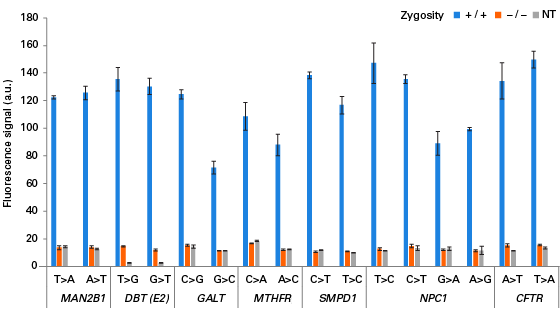
Detecting nucleotide substitutions in several human genomic loci using the Guide-it SNP Screening Kit.

Detecting nucleotide substitutions in several human genomic loci using the Guide-it SNP Screening Kit.

Detecting nucleotide substitutions in several human genomic loci using the Guide-it SNP Screening Kit. Genomic DNA samples (obtained from the Coriell Institute) which were either wild-type or homozygous for the indicated substitutions were analyzed using the Guide-it SNP Screening Kit. All substitutions were successfully detected, as demonstrated by the strong fluorescent signals obtained for samples that were homozygous (blue) for the indicated substitutions relative to signals obtained for wild-type (orange) and negative control (gray) samples.

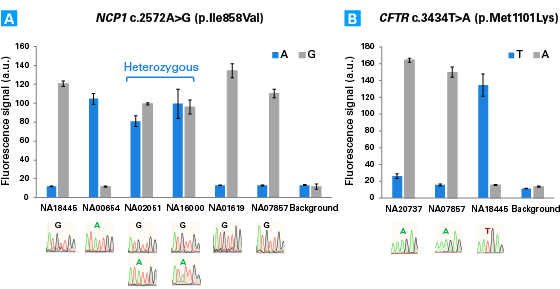
Using the Guide-it SNP Screening Kit for genotyping.

Using the Guide-it SNP Screening Kit for genotyping.

Using the Guide-it SNP Screening Kit for genotyping. Samples from the Coriell Institute carrying SNPs at either of two genomic loci (NCP1 or CFTR genes) were analyzed using the Guide-it SNP Screening Kit (graphs) and by Sanger sequencing. Panel A. Analysis of NCP1. The analysis determined which samples were homozygous or heterozygous for an A>G substitution by employing two flap-probe oligos in independent assays designed to detect either A or G. Panel B. Analysis of CFTR. Analysis of samples that were either wild-type or homozygous for the indicated T>A substitution. All results were confirmed by Sanger sequencing (results shown below the graph under each sample).

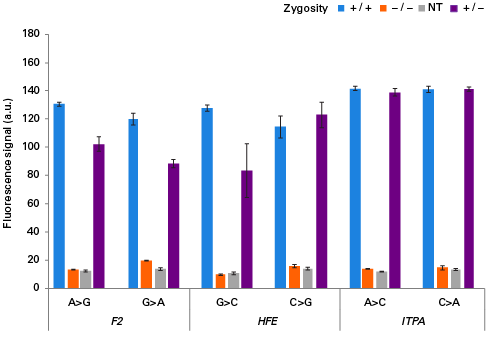
Comparison of SNP screening assay results obtained for homozygous, heterozygous, and wild-type cell samples.

Comparison of SNP screening assay results obtained for homozygous, heterozygous, and wild-type cell samples.

Comparison of SNP screening assay results obtained for homozygous, heterozygous, and wild-type cell samples. The Guide-it SNP Screening Kit was used to assay for each indicated substitution in samples that were homozygous, heterozygous, or wild-type. For each case, fluorescent signals obtained for homozygous and heterozygous samples (blue bars and purple bars, respectively) were of comparable value.

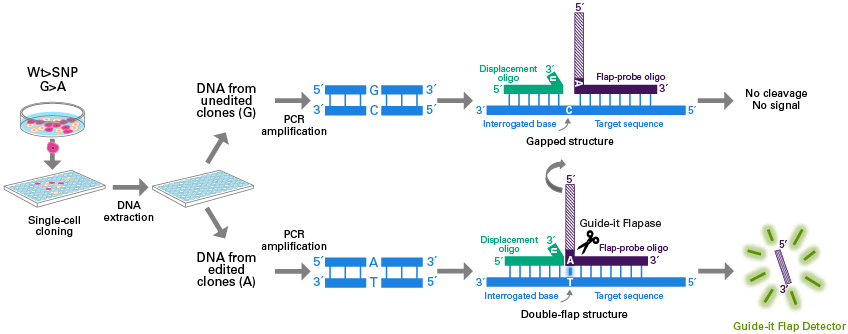
Schematic of the Guide-it SNP Screening Kit workflow.

Schematic of the Guide-it SNP Screening Kit workflow.

Schematic of the Guide-it SNP Screening Kit workflow. This example workflow depicts the detection of a G>A substitution (editing of a wild-type guanine to adenine). Following genome editing, single cells are isolated via FACS or limiting dilution and expanded to clonal cell lines that carry either wild-type (G, top) or successfully edited nucleotides (A, bottom) at the target site. After DNA extraction and subsequent PCR amplification of the region surrounding the target site, the resulting PCR products (blue) are hybridized with two different complementary oligos a displacement oligo (green) and a flap-probe oligo (dark/light purple) that has a fixed, noncomplementary sequence (light purple) that forms a flap. Hybridization of the oligos with the PCR product yields one of two structures depending on the outcome of the editing. When editing has occurred successfully, the flap-probe oligo forms a complete base pairing at the target site yielding a double-flap structure (bottom). Guide-it Flapase is a specific nuclease that only cleaves and releases the flap from the double-flap structure which is detected by the Guide-it Flap Detector, generating a fluorescent signal. When editing has not occurred, the flap-probe oligo does not form a complete pairing at the target site generating a gapped structure (top) that cannot be cleaved by Guide-it Flapase. In this manner, detection of a fluorescent signal using the Guide-it SNP Screening Kit is indicative of whether the desired nucleotide substitution has occurred.